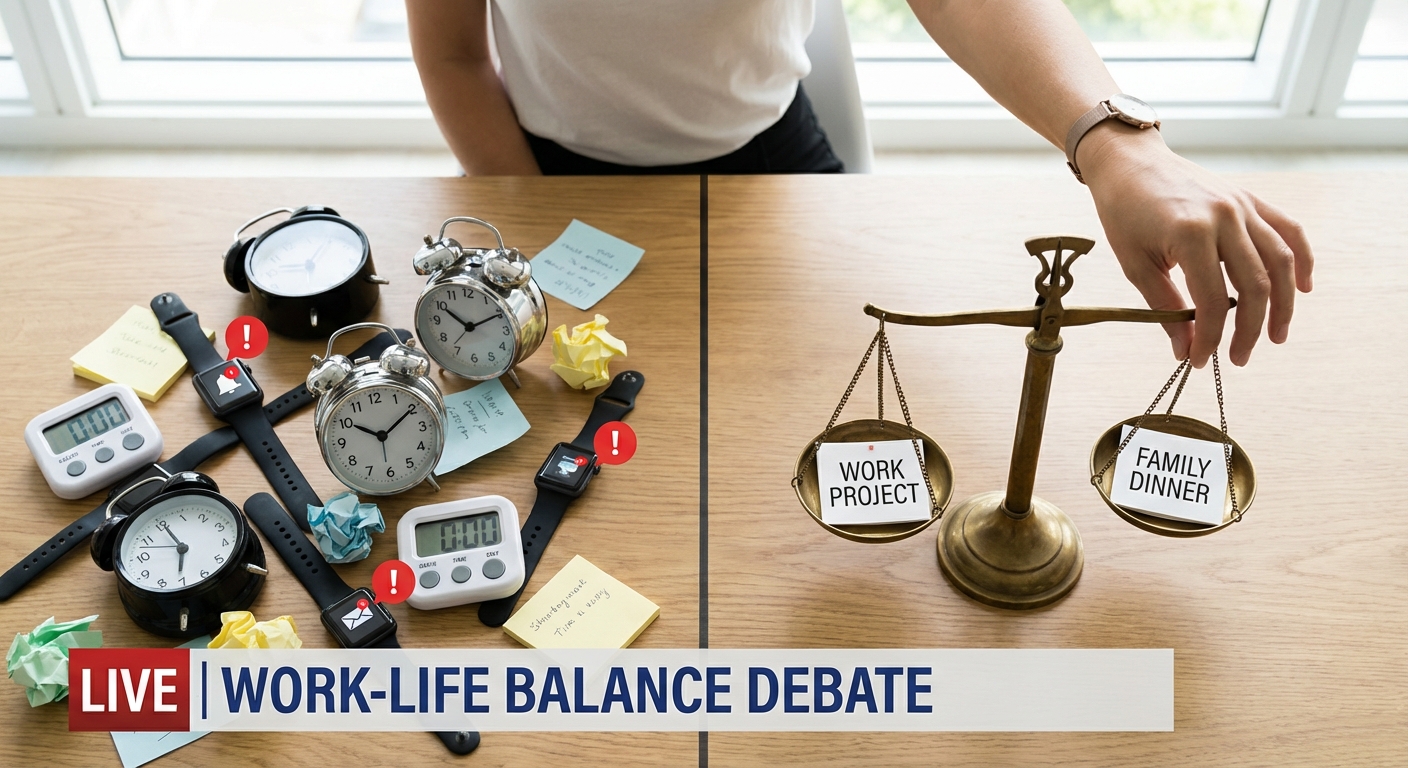
Most advice treats time management like a scheduling puzzle: cram in more, optimize, color-code, repeat. That’s backwards.
Time Management Is Actually Tradeoff Management
Time is fixed. You don’t manage time; you manage tradeoffs. Every yes is many invisible no’s. Time management, at its core, is the skill of making those tradeoffs conscious instead of accidental.
In other words: you’re already excellent at time management. Your calendar perfectly reflects what you’ve actually prioritized—whether you meant to or not. The work is not adding systems on top, but deliberately changing the tradeoffs you are willing to make.
This requires first-principles thinking.
A First‑Principles Model of Time
Let’s strip it down.
You have, on average:
- 16 waking hours per day
- That’s 112 hours per week
- Over a working life, that’s a finite portfolio of attention you’ll never get back
At first principles, your time is governed by three hard constraints:
- Scarcity – You cannot create more hours.
- Irreversibility – Spent time cannot be reclaimed or re-spent.
- Entropy – Unmanaged time decays into low-quality activity.
Any time system that ignores these three is cosmetic.
Given this, the only rational approach to time is:
Allocate your finite hours to the highest-value activities you can sustain, and ruthlessly eliminate or constrain everything else.
That sounds obvious. In practice, almost no one does it.
The Three Layers of Time: Non‑Negotiable, Strategic, Discretionary
Instead of seeing time as one big bucket, treat it as three distinct layers:
Non‑Negotiable Time (Survival Layer)
Sleep, basic health, childcare, essential admin, core job hours (if truly immovable). These are the hours you must spend to keep your life intact.
Strategic Time (Trajectory Layer)
Activities that change your trajectory: deep work, skill building, relationships that matter, health beyond the bare minimum, long-term projects.
Discretionary Time (Noise Layer)
Everything else: scrolling, low-value meetings, default entertainment, errands that exist because you didn’t design better systems.
Time management mistakes happen when:
- Non‑negotiables expand unchecked
- Strategic time is left unprotected
- Discretionary time quietly eats the rest
Your job is to deliberately compress non‑negotiables, protect strategic time, and cap discretionary time.
Framework: The Time Allocation Equation
Move away from task lists. Start with this weekly equation:
Total hours = Non‑negotiable + Strategic + Discretionary
Take a real example:
- Total weekly hours: 168
- Sleep: 8 hours/night → 56 hours
- Job (at desk, including commute): 45 hours
- Basic life admin / childcare / chores: 15 hours
That’s 116 hours accounted for, leaving 52 hours.
Most people never explicitly decide how those 52 hours will be used. They disappear into default behaviors.
Instead, decide from first principles:
- Strategic (trajectory): 25 hours/week
- Deliberate leisure (rest that actually restores): 15 hours/week
- Pure noise cap: 12 hours/week
Now you have constraints:
- You must hit 25 hours of strategic time
- You may not exceed 12 hours of low-quality time
This is tradeoff management in action.
Designing Your Strategic Time Portfolio
Strategic time is where your future comes from. Treat it like an investment portfolio.
Break your 25 weekly strategic hours into 4 categories:
Deep Work (8–12 hrs/week)
Focused, cognitively demanding work that moves key projects. Examples: - Writing proposals instead of responding to email - Designing experiments instead of attending status meetings
Skill Building (4–6 hrs/week)
Structured learning tied to where you want to be in 3–5 years, not just your current role.
Health Upgrades (4–6 hrs/week)
Strength, mobility, conditioning, therapy, sleep quality improvements.
Relationships That Matter (4–6 hrs/week)
Time with people who will still matter in 10 years.
If your calendar doesn’t visibly reflect these buckets, your future is being shaped by inertia, not intention.
The Calendar as a Contract, Not a Wish List
Most calendars are passive: meetings others booked, deadlines others set. You react.
Flip this:
- Start with strategic blocks.
Put 60–90 minute deep work blocks in your calendar first, during your best energy windows.
- Then place non‑negotiables.
Sleep, workouts, family blocks, core meetings.
- Only then allow everything else to fill in.
Admin, errands, optional meetings go last.
Treat your calendar as a contract you’ve signed with yourself. You can renegotiate, but not casually.
A Simple Decision Rule: Cost per Hour, Return per Hour
To decide whether to keep or cut an activity, use two questions:
What is the true cost per hour?
Not just time, but energy, attention residue, emotional drag.
What is the realistic return per hour?
On your money, skills, relationships, health, or satisfaction.
If an activity has high cost, low return, it must be:
- Eliminated
- Delegated
- Or constrained with hard limits
Examples:
- A recurring status meeting that could be an async update
- "Quick" social media checks that fragment your focus
- Doing your own bookkeeping instead of paying someone better at it
Time management becomes clearer when you see each recurring activity as a trade you’re making, week after week.
Guardrails: Make It Hard to Betray Your Future Self
Willpower is a weak foundation. Design structural guardrails instead:
Default blocks
Same deep work windows each week. Same training days. Same planning slot.
Friction for low-value behavior
- Phone in another room during deep work - Social media only on desktop, not on phone - One day per week for errands and appointments
Pre-commitments
- Book classes, not vague intentions to exercise - Commit publicly to deliverables with dates
Guardrails turn good intentions into default behaviors.
A Weekly Review That Actually Matters
Most weekly reviews are glorified to-do reshuffling. Instead, review your tradeoffs.
Take 20–30 minutes and answer:
Where did I spend my time by layer?
Rough percentages: non‑negotiable, strategic, discretionary.
Which 5 hours last week had the highest return?
How can you double those?
Which 5 hours were pure waste or avoidable friction?
How can you eliminate or contain them?
What one constraint can I add this week?
- No meetings before 10 a.m. - Email only twice per day - One evening completely offline
Improvement comes from constraints, not from trying harder.
Respect Your Life Enough to Choose
Time management is not about becoming a productivity machine. It’s about refusing to live a default life.
From first principles:
- Your hours are finite
- Every yes is many no’s
- Your calendar is your actual priorities, not your stated ones
The question is not "How do I do more?" It’s: "What am I willing to trade my life for?"
If you take that question seriously, your approach to time will change on its own.