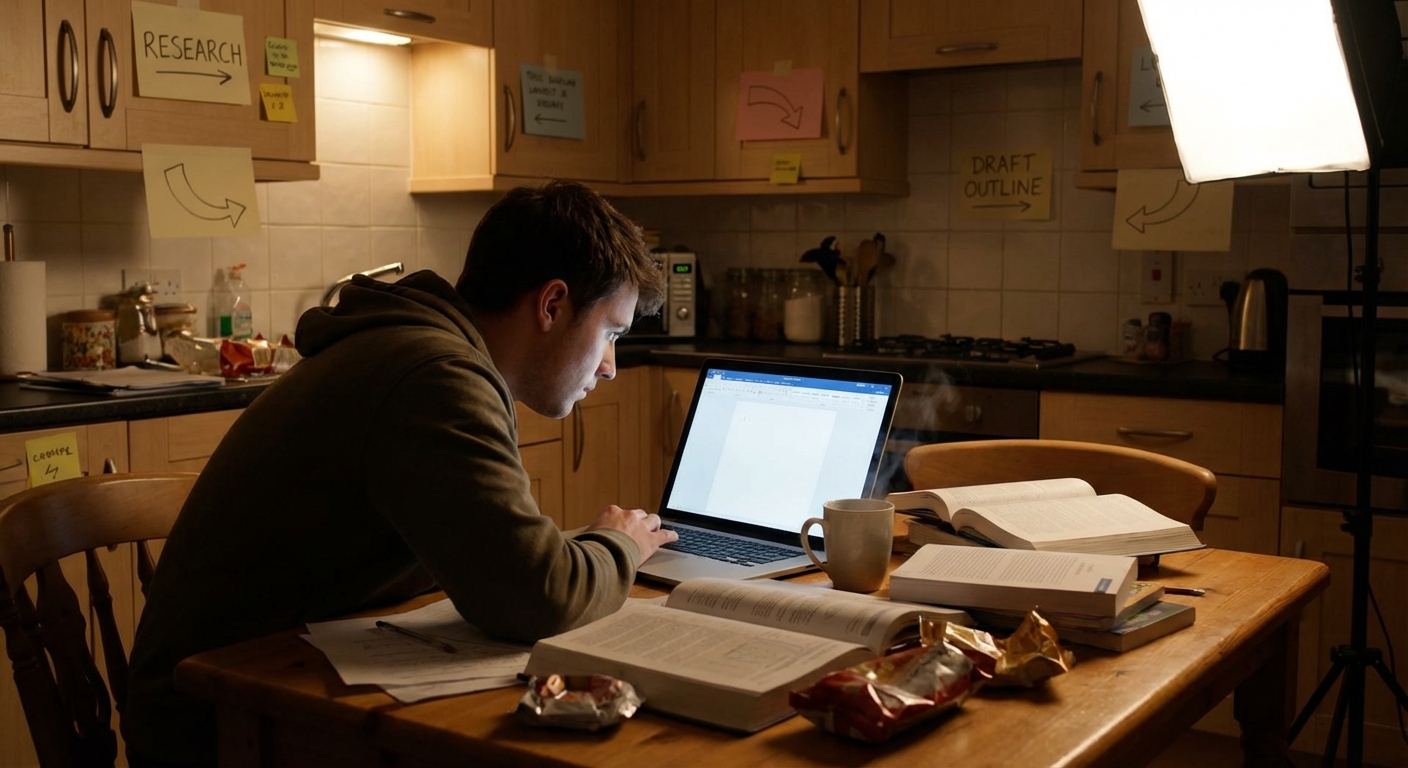
Disliking essays is rational. Many people were taught to write them in an unhelpful way: vague prompts, unclear expectations, and feedback that focused on commas instead of thinking.
If You Dislike Essays, Start Here
You are not bad at writing. You were badly taught.
This guide offers a calm, practical system for producing solid essays without drama—even if you do not enjoy the process. The focus is not on "finding your voice" or "unlocking creativity." It is on getting from zero to a clear, competent essay reliably.
Ground Rule: Your Goal Is Not Genius; It Is Clarity
Perfectionism quietly ruins many essays before they start.
Instead of aiming for brilliance, aim for something more realistic and useful:
"When a smart stranger reads this, they understand what I think and why."
That's it.
Once you accept that, you can use systems instead of waiting for inspiration.
The RELAX Framework
Here's a simple, repeatable process to write essays without panic. Call it RELAX:
- R – Reduce the problem. Turn the assignment into a smaller, concrete question.
- E – Extract raw material. Brain-dump everything you already know.
- L – Link ideas. Group and order the raw material into a simple structure.
- A – Articulate clearly. Turn bullet points into straightforward paragraphs.
- X – eXamine once. One focused editing pass, then stop.
We'll go through each step with practical instructions.
R — Reduce the Problem
Most prompts are too big:
- "Discuss the impact of technology on society."
- "Explain the causes of World War I."
You can't write a sharp essay about "technology" or "society" in 1,500 words. Reduce the target.
How to do it:
Ask: What specific angle can I handle in this space?
2. Answer in one narrow sentence.
Examples:
- Instead of "impact of technology on society":
- "How smartphones changed my family's dinner conversations."
- "How remote work tools reshaped hiring in small startups."
- Instead of "causes of World War I":
- "Why the alliance system made a small crisis likely to turn into a large war."
If you're in a formal context (exam, school), make sure your narrowed question still clearly relates to the original prompt.
Write your reduced question at the top of the page. This is your north star.
E — Extract Raw Material
Most people stare at the blank page trying to write polished sentences. That is like trying to plate a dish before you've cooked anything.
Your first job is to get ingredients onto the table.
10–15 minute brain-dump:
- Set a timer for 10–15 minutes.
- Write bullet points only.
- Capture:
- Facts you remember
- Examples or stories
- Opinions or doubts
- Questions you still have
Do not:
- Fix grammar
- Worry about order
- Judge whether a point is good enough
If your reduced question is: "How remote work tools reshaped hiring in small startups," your raw material might look like:
- Ex: friend hired by US startup while living in another country.
- Tools: Zoom, Slack, GitHub.
- Benefits: bigger talent pool, lower office costs.
- Problems: time zones, culture, loneliness.
- Covid as forcing function.
- Some companies went back to office—why?
That's already enough to work with.
L — Link Ideas
Now you sort and group.
- Circle or star the 3–4 most important points. These will become main sections.
- Cluster related bullets under them. Use arrows or rewrite them grouped.
Continuing the remote work example, you might end up with:
- Point 1: Access to global talent.
- Friend's story.
- Wider hiring pool.
- Lower office costs.
- Point 2: New challenges.
- Time zones.
- Culture building.
- Loneliness.
- Point 3: Conditions for success.
- Clear communication norms.
- Good documentation.
- Some companies failing and returning to office.
Now sketch a basic structure:
- Introduction: how remote tools opened hiring + your main claim.
- Section 1: access to global talent.
- Section 2: serious challenges.
- Section 3: what separates companies that make it work from those that don't.
- Conclusion: what this means for future workers and small startups.
This is enough. Stop outlining and move on.
A — Articulate Clearly
Now you turn your outline into paragraphs.
Rules that make this easier:
- One idea per paragraph.
- First sentence of each paragraph should say the point of that paragraph.
- Use short, direct sentences.
- Prefer concrete examples over general statements.
Example paragraph pattern:
"Remote work tools have let small startups hire talent they could never reach before. My friend Ana, a designer in Brazil, was hired by a five-person startup in Germany during the pandemic. The founders could not match big-city salaries, but by hiring remotely they found someone with exactly the skills they needed. Tools like Zoom and Figma made daily collaboration possible. For the startup, this meant access to a global talent pool without the cost of an office in Berlin."
Is it fancy? No. Is it clear? Yes. That is enough.
Write your introduction last if it helps. A simple intro format:
- One or two sentences of context.
- One sentence stating your reduced question.
- One sentence stating your answer (your main claim).
Example:
"In the last few years, remote work tools have spread from big companies to tiny startups. For small teams, these tools didn't just change where people worked; they changed who could be hired. In this essay, I will argue that remote tools have opened hiring to a global talent pool but only benefit startups that take culture and communication seriously."
That is enough to orient the reader.
X — eXamine Once
You do not need to rewrite forever. You need one focused pass.
Use this order:
Structure check (macro):
- Does the introduction clearly state the question and your answer? - Does each section relate to that answer? - Do you have a real conclusion (what it all means)?
Clarity check (paragraph):
- Is the first sentence of each paragraph clear? - Can you replace abstract words with concrete ones?
Surface check (sentence and grammar):
- Fix obvious typos. - Read one paragraph aloud. If you run out of breath, split long sentences.
Set a time limit: 20–30 minutes for a short essay, 45–60 for a longer one. When the timer ends, you are done.
Addressing Common Fears Directly
Fear 1: "I have nothing original to say."
You probably don't, and that's fine. The bar for a solid essay is not originality. It is:
- Clear explanation
- Honest engagement with the topic
- Coherent structure
If an insight is obvious to you but clearly explained, it's still useful to many readers.
Fear 2: "I don't sound smart enough."
Trying to sound smart usually leads to cluttered sentences and buzzwords. Professionals prefer clarity:
- Instead of "utilize," write "use."
- Instead of "in terms of," delete or replace with something specific.
- Instead of "it is important to note that," just state the thing.
Smart people value precise thinking, not decorative language.
Fear 3: "My first draft is terrible."
It should be. Writing is not transcription of finished thoughts. It is the process of discovering and refining thoughts.
If your first draft looks bad, it means you are doing the work on the page instead of in your head. That is progress.
When and How to Raise Your Standards
Once RELAX feels manageable, you can raise the bar deliberately:
- Add a short counterargument section to every essay.
- Use at least one external source or quote and integrate it.
- Ask a peer to challenge your main point and use that to strengthen your next draft.
But do this after you can reliably complete essays, not before.
Essays as Quiet Confidence Builders
You may never love writing essays. You don't have to. You only need to trust that you can move from prompt to finished piece without panic.
Use RELAX:
- Reduce the problem.
- Extract raw material.
- Link ideas.
- Articulate clearly.
- eXamine once.
Follow the steps, hit submit, and move on with your life. Over time, you'll notice something subtle: not that essays get easier (they remain work), but that you get calmer and more competent when facing complex questions.
That is what matters.