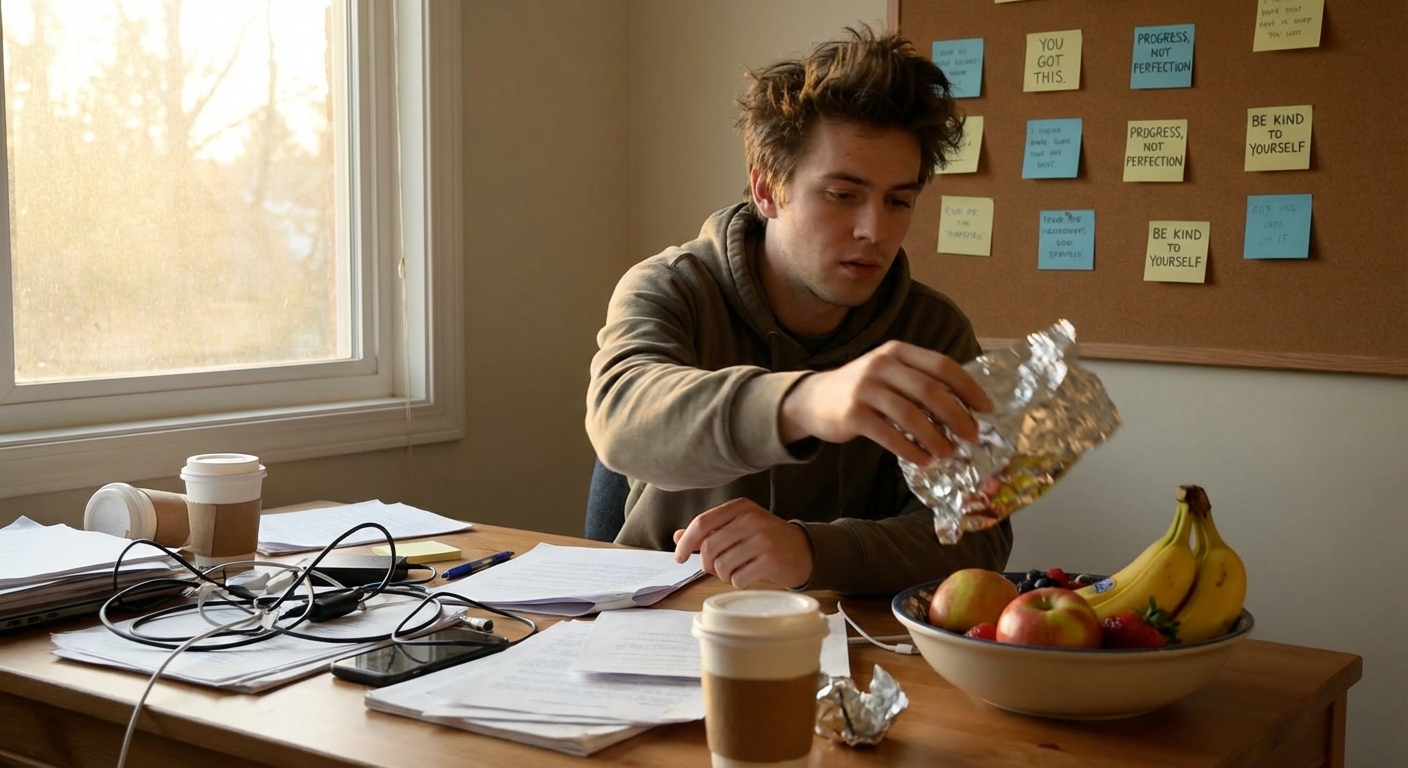
Change advice usually assumes you have three things you probably don’t:
The Myth of the Clean Slate
- Ample free time
- Stable routines
- Emotional bandwidth
Real life is messier:
- Demanding job or business
- Family obligations
- Health issues
- Constant low-level stress
You want better habits, but you’re already at capacity. The idea of adding more sounds exhausting.
This guide is about building habits that fit inside a fast, overloaded life instead of waiting for a perfect future that never arrives.
First Principle: Capacity Is a Hard Constraint, Not a Moral Failing
You can want change and still not have the capacity for big overhauls.
Your current bandwidth is shaped by:
- Sleep
- Mental load
- Financial stress
- Physical health
- Number of people who depend on you
Pretending these constraints don’t exist doesn’t make you strong; it makes you delusional.
Habit design must obey capacity. If it doesn’t, you will:
- Start strong for a week
- Crash
- Blame yourself instead of the unrealistic plan
So we design slow habits: small, durable changes that respect your current conditions but still move you forward.
The 1% Rule: What Actually Compounds
Massive action is dramatic, but rarely sustainable.
A more realistic operating rule:
Increase the quality of your days by ~1% at a time, but make those gains permanent.
This means:
- 5–10 minute habits, not hour-long routines
- One domain at a time, not total life reinvention
- No reliance on rare bursts of motivation
Compounding doesn’t care how heroic your first week was. It only cares about what you repeat.
A Framework for Slow Habit Design
Use this four-part approach:
- Pick one leverage point.
- Design a laughably small action.
- Attach it to an existing anchor.
- Protect it with rules made for bad days.
1. Pick One Leverage Point
Ask: If this area improved modestly, would other parts of life get easier?
Common leverage points:
- Sleep quality
- Physical movement
- Mental load (planning, organization)
- Emotional regulation (stress response)
Pick one. Not three. Not five.
If you’re overwhelmed, sleep or stress management is almost always a better first target than productivity.
2. Design a Laughably Small Action
Reduce the habit until your first reaction is: "That’s too small to matter."
Examples:
- Sleep: Dim screens and lights 20 minutes before bed.
- Movement: 5-minute walk after one existing meal.
- Planning: Write tomorrow’s top 1–2 tasks on a sticky note.
- Stress: 3 slow breaths before opening email.
The win condition is not "transform my life in a week." It’s "so small I can do it even when exhausted."
3. Attach It to an Existing Anchor
An anchor is something you already do predictably:
- "After I brush my teeth"
- "After I pour my morning coffee"
- "After I close my laptop at work"
You’re not trying to create time from nowhere. You’re piggybacking on existing rhythms.
Example:
- After I make coffee → write my top 1–2 priorities.
- After dinner → 5-minute walk.
- After putting my phone on charger → read 2 pages of a book.
4. Protect It With Bad-Day Rules
Design the habit assuming:
- You will be tired.
- Kids will get sick.
- Work will explode.
Bad-day rule example:
- Normal: 5-minute walk after dinner.
- Bad day: Walk to the end of the street and back. Done.
Your only job on bad days is not to break the pattern. You’re preserving identity and continuity, not chasing progress.
Real Example: Overloaded Parent Improving Health Without Extra Time
Constraints:
- Two young kids
- Full-time job
- Limited money and energy
Leverage point chosen: Sleep and stress.
Habits implemented over 3 months (sequentially, not all at once):
Month 1: Screen Dimmer Habit
- Anchor: After kids’ bedtime. - Action: Enable night mode on all screens and turn living room lights down. - Bad-day rule: Even if TV stays on, lights and screen dimmer still go on.
Month 2: 5-Minute Reset Walk
- Anchor: After work, before entering home. - Action: 5-minute walk around the block to transition out of work mode. - Bad-day rule: If raining, 2 minutes of slow indoor pacing and breathing.
Month 3: Tomorrow on a Sticky Note
- Anchor: After brushing teeth. - Action: Write 1–2 important tasks for tomorrow; place note near keys. - Bad-day rule: If utterly exhausted, just write one word ("email," "report").
Outcomes after several months:
- Slightly better sleep
- Less emotional spillover from work to home
- Mornings less chaotic
No gym membership. No 5am club. Just slow, compounding upgrades.
How to Deal With Guilt and Ambition Clash
If you’re ambitious, slow habits can feel insulting. You want to do more.
But your track record matters. If going big has repeatedly led to burnout and collapse, that’s data.
Reframe:
- The point of small habits is not to stay small.
- They create a platform of stability from which bigger changes become feasible.
You can make this explicit with phases:
- Stabilize (4–8 weeks): Only small, easy habits. Goal: consistency.
- Strengthen (next 4–8 weeks): Slightly increase duration or intensity.
- Stretch (optional): Add one more habit in a new domain.
Ambition is useful. Just route it into building systems, not adrenaline-fueled sprints.
Choosing What to Ignore (On Purpose)
When you’re overloaded, what you don’t try to change is as important as what you do.
Give yourself explicit permission to ignore certain areas for now:
- "No major diet overhaul for the next 2 months. I’m focusing on sleep."
- "No productivity tools experiments. Just one sticky note habit."
This isn’t giving up. It’s sequencing.
Trying to "optimize everything" is usually just a sophisticated way to avoid committing to one concrete change.
Signal to Yourself That This Is Serious
Small habits can feel trivial, so they get dropped first when stress rises.
Counter that by giving them visible weight:
- Put the habit as an actual recurring calendar event.
- Tell one trusted person what you’re doing and why.
- Track it on paper where you can see the streak.
The size of the habit can be tiny. The seriousness of your commitment shouldn’t be.
A Minimal Slow-Habit Starter Kit
If you’re already stretched thin, start with this three-habit kit:
Sleep Guardrail
- After 9:30pm (or your chosen time), no social media apps. Move phone to charge outside bedroom if possible.
Micro-Movement
- After one existing meal, walk for 5 minutes.
Tomorrow’s One Thing
- After brushing teeth at night, write tomorrow’s single most important action.
Run this for 4 weeks. Do not add anything.
If you miss a day, resume the next. Don’t compensate by doubling the next day. That’s how you break systems.
The Point of Slow Habits in a Fast Life
You don’t earn extra points for suffering. You don’t get a medal for dramatic but unsustainable change.
You get results from whatever you can keep doing when life is chaotic, you’re tired, and nobody is watching.
Slow habits respect that reality.
They are not about settling. They are about building a stable base on which future, faster changes can actually stand.
Given the choice between a heroic 30-day spree and a modest habit you’ll still be doing next year, choose the latter.
That’s how serious adults change: not with spectacle, but with quiet, repeated action that fits inside the life they actually have.